Search This Blog

Tuesday, September 13, 2011

April 1942. Leo is drafted.

Leo was always the sensitive one, the one who was least robust of the four children, the one that everyone worried about. He had bouts of moodiness as a child and teenager, and was probably overshadowed by his boisterous and confident twin sister and his talented elder brother.


The first letter here is written by the mother to her husband. In it she describes her reservations about Leo's future in the army. Following this is the first letter from Leo.


April 20th, 1942

Vienna

Dear A


Enclosed is Leo’s first letter. It just arrived today, though it was written on the 15th. He had carried it around in his pocket. He’s so absent minded--I can just imagine his state of mind. He’s such an unlucky boy, he’ll probably have to shoot someone straight away, and I can imagine what sort of miserable expression he’ll have on his face when he has to pull the trigger! In every respect he will struggle, much more so than Andreas--who had his boot camp as a preparation, and was in much better shape. I feel sorry for Leo because he will suffer terribly, and in addition to that the hunger, the cold, etc. Yesterday the Attems and Galen boys were on leave and they rang up as they had their driving school elsewhere. They weren’t able to see Leo, and wanted to visit him today instead. That will cheer him up a bit. I gave them a little care package to take with them, which will also do him good!


April 15, 1942

Leo to his mother


Return address on letter reads “Pt Sch Winkelbauer, 2. Pz.Ers.Abt 4; Wien Mödling


Dear Mami


Just a quick letter! I have a couple of requests-- 1. please can you send me some dry shaving creme, and 2. Please if at all possible can you please send some shoe polishing materials--here we have nothing! Please send as much as possible.


Do you know Franzi’s address yet? I am known here for being a glutton. Today the staff sergeant praised me. If things continue that way, I’ll be fine.


Best wishes and a kiss

Leo


[on one of the reverse side flaps]

Dear Mami, many thanks for your sweet note which I found in my suitcase. Please don’t praise, as that makes me soft. And then sometimes that hurts.


March and April 1942, a recent recruit writes home


These letters were written quite early on, while the eldest boy Andreas--he signs himself Alter, meaning the "older one"--is on training. They still has something of letters home from a summer camp, despite the references to lung worm and hard labour. The tone is cheerful, and he's very pleased to have been singled out for services as a draughtsman, since he had hoped to be an architect. The locker is also a matter of some pride.


The watercolour above probably dates a little later than these letters, but I include it here to show what his talents were as a caricaturist. The long arms and legs were a family feature, and the title of the picture as "healthy optimism".


March 28, 1942

Andreas to Parents

Frankstadt (training area)


Dear Mami and Papi


I was so pleased to be able to speak to Mami on Thursday. It was unfortunately not possible this Saturday and Sunday to get to Zanchtel because I was on duty. I shall look forward to the Sunday after Easter all the more!


So, what should I write to you about. Everything is the same here, and Frankstadt is, and remains, a pig-headed and tough kind of a place. Something did happen however which was wonderful for me. I think I wrote to you already that I had done a couple of drawings which I thought were quite good, and they not only gained the praise and approval of my superior, Lt. Dr Gerhold, but also the company chief and my former company chief. For this reason, I have been offered the honourable job of making fresco-type caricatures of the entire unit. Because I am short of both time and practice, I had to decline. However, what I will do is make sketches, and then produce them at 1:1 size and paint them, and then pass them on to a new recruit who is architect by profession, and he will complete the work. So you can imagine that I am walking around with a song in my heart, and on the other hand feel nervous that I may not be up to the job. So please keep your fingers crossed. This would be my first real commission.


April 2, 1942


Dear Mami and Papi


First of all I’d like to send you my very best wishes for Easter, and thank you for the two wonderful Easter packages you sent. I am going to try to control myself and open them on Easter Saturday, since I’m hoping to be together with Clemens Wainbold and von Hornstein at the Seilerns in Millatitz. I’m not even sure if I can go, since we have to go at 12 noon, and apparently need to be back in the afternoon for a rehearsal to be standard bearers in the parade for the swearing in ceremony. Hopefully I’ll get leave and be able to go, otherwise I’ll be sitting here--in which case I’ll be extra grateful for the package and the RM 50. Many thanks; my wallet is feeling replenished, and therefore I’m feeling much better.


As we’ve been having driving school since last Tuesday I have more time to write. I’d like to describe to you my locker. I do this as I am quite proud of it (when it’s tidy and ready for inspection!). The top shelf is my pride and joy! A bookshelf that looks like something from a library: Brockhaus, Goethe, HDVs and piles of drawings. Then my neatly folded laundry, and behind it my piles of letters and more drawings. My peaked cap finishes off the row of items on the top shelf. After the first shelf, the shelf with my toiletries, then then come the uniforms. Makes for impressive viewing! To the front is my gun, my very well polished ammo bag, a belt with a polished buckle, which I use as a mirror to shave, and my good shoes, which are the envy of all as they are so well polished. Then I have the so-called magic bag (the bag that used to hold my ski boots), in which I keep 10 large boxes of matches which I have bought for you. I’m not allowed to post them because of the fire hazard, so I’ll give them to Mami when I see her.


The door of the locker is also a matter of great pride. Now, now, you needn’t think that I’ve decorated it with photos of attractive girls...no, it’s been done with taste! Drawings, photos of home, things to inspire me. That’s my locker. By that I mean that’s what’s good about my locker. Behind the magic bag there is a little space where I keep dirty socks, filthy handkerchiefs, khaki shirts, and the dark coloured undershorts and almost black neckkerchiefs. All these things that need washing lurk in the dark and produce an unpleasant atmosphere for the rest in the locker, until I give up the dirty things on Mondays for washing, and receive it clean on Fridays.


For now, the driving school is a relaxing break from the normal grind, and a time to recharge batteries. I have time to look after my poor feet, and let them heal. My cough is also much better because of it. Thank God it will go completely now, since up to now I simply couldn’t get better with all that I was doing. Before this we had hard sweaty training in the mornings, so much so that our shirts stuck to us, then we had to stand around and listen to a lecture, during which your every effort was inspected. Under such circumstances no one can rid themselves of a cough. Now I’m on the road to recovery, and hope to rid myself of my lung worms soon.


I’d also like to write about something else. At Easter I am hoping to go to the Seilerns, as you know, with von Hornstein and Clemens. I spoke about it with von Hornstein. The poor fellow, he’s very upset. Today he learned that as an officer-hopeful he’s been removed from the list--no chance. Why, I am not entirely sure, he just said the following: “it’s because of my parents”. He can still make the rank of officer, but he will only ever be a reserve officer.


Well, time’s rushing on, and I have to get ready for duty.


1000x love and happy Easter from

your Alter

Monday, September 12, 2011

Finding the resting place of Leo Winkelbauer


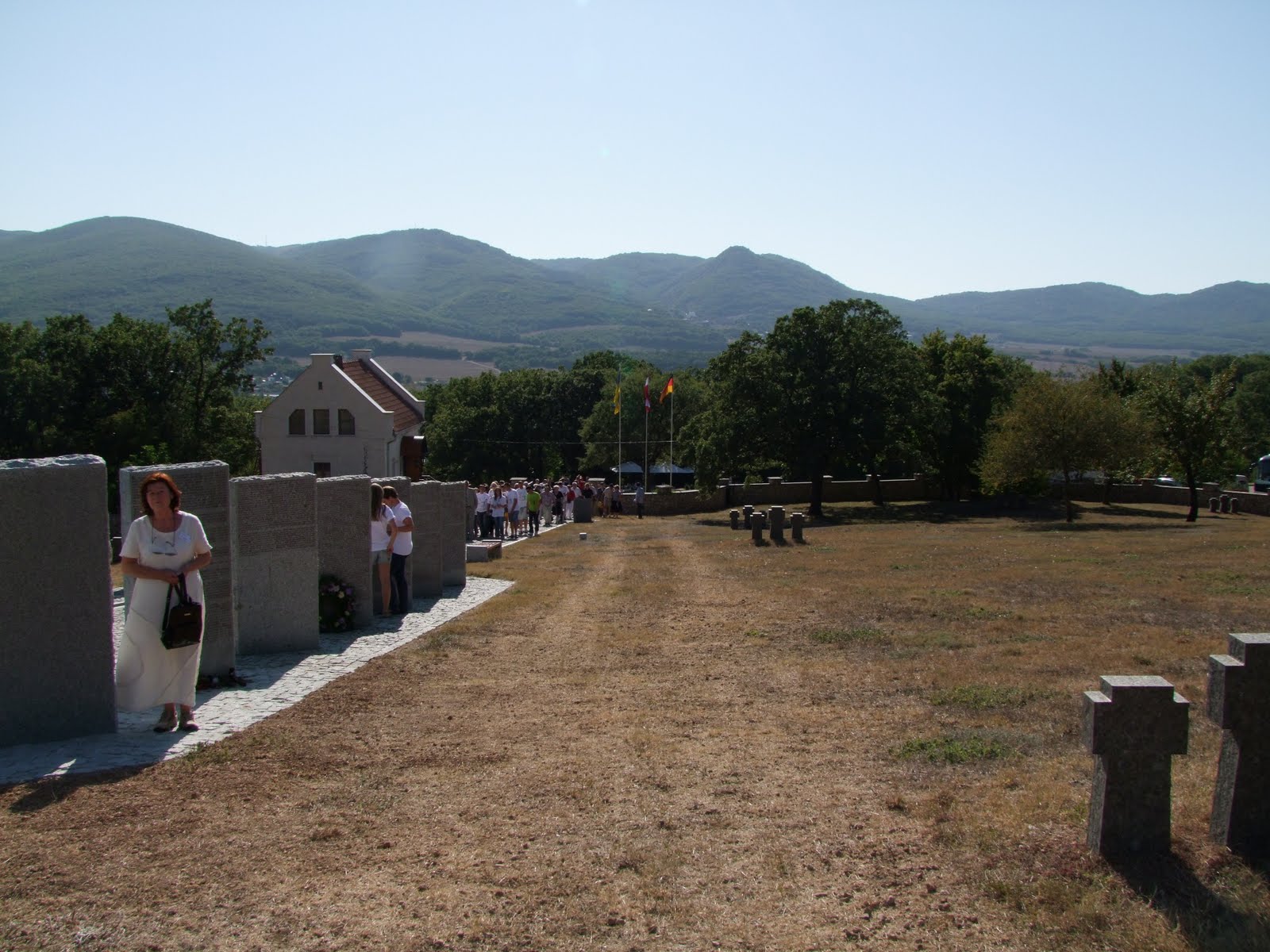
On the 27th of August 2011, a ceremony was held to commemorate the tenth anniversary of the opening of the German Soldiers' Cemetery in Gontscharnoye, a small town located between Sevastopol and Yalta on the Crimean peninsula. The cemetery was opened as part of a cooperative effort between the Ukrainian and German governments, to provide both a suitable memorial as well as collect up as many remains as possible from unmarked graves across the country where they laid unrecognised and in some cases entirely lost. Under the Soviet Union, organised war cemeteries, such as can be found all over Europe, were not possible. The Ukraine, a young country that gained independence in 1991, put the tract of land in Gontscharnoye--one of several--at the disposal of the German government, and it is maintained through the German War Graves Association (VDK -- Volksbund Deutsche Kriegsgräberfürsorge e.V), largely by voluntary contributions.

I received notice of this memorial celebration in June from the VDK. My contact details were on file as a result of my enquiry about my uncles earlier in the year. The letter said that Leo Winkelbauer's name appeared on the list of soldiers who were remembered in the memorial books contained within the "House of Remembrance" at the cemetery, but no further information was given. I had received other advice, obtained through the local museum in Melitopol, saying that it was unlikely that any of the bodies buried after the battle of that town would have been moved, and neither were any of them marked with individual headstones.

Despite there being little reason to believe that Leo's remains were at the cemetery in Gontscharnoye, we decided to attend the ceremony.

On a glorious burnished late summer afternoon, some two hundred people gathered in a clearing in an oak forest, a sunny flank surrounded on three sides by oak forests covered hills, facing south towards the Black Sea. From our gathering place there was nothing to be seen except a panorama of forest going gold and purple in the gathering evening. A brass band from the Sevastopol navy stood to attention on a rise above the main memorial, and a colour guard lined the walk as the family members, local officials, embassy staff and other participants gathered to the sunset service.

As I walked up the path to where the benches had been put out for the attendees, I stopped to look at the rows of standing granite slabs that faced the path, each carved with the names of the soldiers who are now buried there--some 25,000 to date. There are groups of of them at several locations on the cemetery grounds, but these greeted the visitor as they made the climb to main memorial, and my eye fell to those on the left. Walking up, I followed the names alphabetically, the As, the Bs, and so on, searching through the alphabet, not bothering to look at the backs of slabs, where names were also inscribed, but just looking--generally--for the last part of the alphabet, the way you do when you pick up a dictionary and flip through the pages an inch at a time to find your part of the alphabet.

Then my eye fell onto the Ws, the sun shining on them and drawing me in. Weber, Weinfurtner, Wertheimer, Wilke, Winkel.....Winkelbauer. There was his name. Leonhard Winkelbauer, born 25.5.1923, a twin in fact, fallen in battle on the 21st of October twenty years later. I was able to find someone who knew about the planning of the cemetery, and the transferal of human remains to it over the past ten years. We consulted the memorial books in the House of Remembrance and discovered that his remains were taken from a mass grave in Melitopol, the occupants of which were documented, and moved to a section of the new cemetery for the unnamed. He was moved to Gontscharnoye in 2003, the same year his twin died.

The memorial service was conducted in German and Ukrainian, and included brief speeches by the director of the VDK, the German ambassador, the representative from the Austrian Black Cross (the VDK equivalent in Austria), members of the clergy, and the major of Sevastopol. A youth group made up of young people from Germany, Ukraine, Belarus and Russia made a presentation about one of the soldiers, reading his letters, telling of his life, a story as ordinary and poignant as the one described here. Every speaker had an interpreter by their side, so that each part of the ceremony could be equally appreciated by all.

A former German soldier, 91 years old, attended with with his children and grandchildren. A crowd gathered around him. Then the group stepped back to allow a Russian soldier, also over 90 and wearing his medals, and another comrade, this time a Ukrainian. They embraced and shook hands. The Russian saluted his new German friend, now wheelchair bound. One of the event helpers struggled to keep up as interpreter. "He says you are now my friend" explained the interpreter to the German. "To friendship" he replied.

By the time the service ended the sun had fallen behind the hills, leaving the gathering to descend the slope to the picnic tables which had been set up with traditional fare: chicken and pilaf prepared in a field kitchen, platters of locally grown produce on the table, and loaves of fresh bread, the local ham, and for each a small glass for a toast of vodka.

I let the others go ahead and remained a little longer on the meadow in the dusk. For the first time in 68 years, this boy--I cannot think of him as a man, as he was younger even than my own son is now--was close to his family. Rest in peace, Leo.


Wednesday, August 24, 2011

About renamed streets and job descriptions 1940


Here are two letters written by my grandfather to my grandmother. The one on the left was from his office at the Dollfussplatz 6, where he was Primarius, or chief surgeon at one of Vienna's largest hospitals. The date on that one is September 1939. Less than a year later things had changed; gone was his professional designation and the street had been renamed Herrmann Göringplatz. The street, which has been renamed several times during history according to the political style of the day, is now known as the Roosevelt Platz, and is very close to the family house in the Währingerstrasse. If you look closely, you can see that the phone number remained unchanged during all this.

There's an interesting footnote about Dollfuss, who was Austria's anti-facist chancellor until his assassination in 1934 by the Nazis. His children had been given a miniature motorised Italian made sportscar. Having no appropriate place to use this fantastic object, Dollfuss brought it, with his children, to my father's house, which had extensive gardens and paths, and there it was driven around in circles between the greenhouses and the carriage house. As far as I know, neither my father or any of his siblings were ever allowed to have a turn using it!

Andreas writes for the first time from training camp 19 October 1941


Andreas was drafted into a reservist unit on the 1st of October 1941. His training area was in Frankstadt, in Moravia, now in the eastern part of the Czech Republic. As the eldest, he was the first to go.

This is the first of his letters. Interestingly, it has not been written to the family, but to the beloved nanny and later cook, Marie. Marie came to the family as a young teenager from the agricultural and wine country north of Vienna, just in time for Andreas' birth. She was famously afraid of answering the telephone when she first encountered one. This letter contains the first mention of a theme which arises again and again in the letters of the siblings: they were viewing their happy and well-fed childhoods with much appreciation. I can't help feeling that in writing to ask forgiveness for childish misbehaviour, he is anticipating a time when it would be good to know he had put everything to rights. There is also, I think, a touch of homesickness in the final lines.


19 October 1941

Frankstadt


Dear Marie


Firstly 1000 thanks for your lovely letter, which gave me great pleasure to receive. Please accept my apologies for not answering you until now, but other than Saturdays and Sundays I have no time to write.


You will be able to imagine just how much I appreciate every package sent to me. I especially enjoyed the condensed milk, which I am consuming in tiny amounts to prolong the experience. It’s just occurred to me, that in my hurry to depart I completely forgot the acacia honey. I will appreciate it all the more when I come home on leave. When that will be is not known at the moment, but I am hoping to be home for Christmas. Whenever! When I come I will bring my food ration coupons with me, and I am looking forward to eating properly, and want to sleep and just enjoy myself.


You know, sometimes in the evenings before I fall asleep, I think about the lovely teas you prepared in the kitchen, all the wonderful bread, and the butter, and honey too. I am only now beginning to realize just how good we had it at home. I am also thinking with great appreciation on the “Ham-and-Eggs” you used to prepare, as well as the frequently prepared “pre-lunch”. You know, even if I was a pain in the neck to you at times, I never meant it, I was just being childish.


I must close now, as I have office duty to attend to , and everything needs to be ship-shape. Don’t forget me now, think about your Andi, and rest assured, that I am always with all of you in my thoughts.


with love from

your long-legged Andi


Tuesday, August 23, 2011

28th March, 1940. Rudolf, aged 14, is called up

This document, which was bundled with the letters, is particularly chilling for me, both as a daughter, as well as a mother. My father was 14 when this letter, written on the thinnest foolscap and stamped vigorously on the bottom with the official insignia of the author of this "proclamation", arrived in the post.

What sticks out when you read it is the relentless use of the imperative tone in nearly every sentence. "Your child will be there". "He will wear the swastika armband". "Your child will fulfil their role".

I'm also struck by the fact that the Hitler Youth of Vienna had established themselves on the Tuchlauben 14, today a street of very smart shops not far from St Stephens cathedral. What offices did they commandeer to get the office, I wonder.

At the beginning, my father's forays with the Hitler Youth were relatively benign, and involved weekly meetings, song singing, marching and turning up for parades, etc. On one such occasion he stood too long in his short trousered uniform outside in the bitter cold and contracted pneumonia. Under local anaesthetic, part of a rib was removed to gain access to the affected lung and drain it. He was lucky to survive. By the time he was 16, my father's school had moved to the outskirts of town to provide anti-aircraft defense, but more about that in another posting.


28 March 1940


NSDAP Hitler Youth

Wien, Tuchlauben 1


Proclamation number 501


Dear Parents!


On the morning of 30 March 1940, hundreds of thousands of youths from the entire Reich who have reached the age of fourteen will join the ranks of German’s youth and will take part in an obligatory celebration, which will inaugurate them into the Hitler Youth. Most of them will in this year leave school and begin their working life, but the others too will have reached a turning point in their lives. They will be joining the ranks of those who direct their lives towards fighting for the communal life of the German people.


Your child will be there. He will wear the swastika arm band. He will discover the same camaraderie and kinship, and will be called up to the hard law of discipline and responsibility. Through his continuing personal dedication, he will prove that he has what is necessary to belong to the growth of the party, and the core of the Hitler Youth.


The job of educating the Hitler Youth can only be done with the full support of the parents. Therefore you also, as parents, have an obligation to participate in this duty, and in the calling up of your child. Therefore we also invite you to take part in the obligatory celebration. The day should also be marked within your family as a special day of celebration.


The majority of fourteen year olds will be engaged in the following units: transport, navy, air, communications, cavalry, sport, and patrol. The differing nature of these roles should prepare them for the lives that lie ahead of them. You and your child will appear on March 31, 1940 in the afternoon from 3 pm until 6pm, on the grounds of the Messepalast. You are warmly welcomed.


In this time where the entire German nation has been brought to decisive battle, your child will fulfill their role. This is only possible if we have your trust and complete support.


Heil Hitler!


Author of Proclamation 501


Karl Pfoser

Oberstammführer


Saturday, August 20, 2011

Parents and Politics


Before I write about the politics of the war as it came to my family in 1939, I should say a few words about my grandparents, who you see here in these photographs. On the left is my grandmother, in her WW1 nurse's uniform. She served as a nurse with the order of the Knights of Malta on the Italian front from 1914 to 1918. There, she met my grandfather, who at that time had recently graduated from medical school. They married in 1922; the photo on the right shows them on their wedding day. In a memoir, she wrote this about her arrival in the Alto Aldige of northern Italy:

We set up a small hospital and soon had plenty of work. The hospital was bombed by planes, which used both light and heavy ordinance. If a 30.5 mortar bomb was shot at us anywhere in the area, the lids on the cooking pots jumped and jangled; the patients screamed. There was much work during the offensive. Often three days and nights straight without any rest for us. But it was a time in which one gave one’s entire strength for our beloved Fatherland. We helped the poor wounded and dying not only with physical and medical support, but also tried to help them emotionally, and provide them with maternal care.


I spent that first Christmas on the front far from my parents and siblings. We received a number of wounded with terrible head injuries, screaming, confused, dying. It was a ghastly night. I found leg amputations a most terrible shock, and in this operation I had to assist. I had to hold the leg of the poor man, and then as it was dismembered, it fell heavily into my arms. I remember the first detatched eyeball, and the reproachful look it cast upon you. We nursed and helped to the best of our abilities in the operating room.


I think it would be a fair characterisation to say that after their war experiences together, my grandparents had a very good idea about what was coming when war was declared in September 1939. Neither of them was political. My grandfather, who at the outbreak of the war held an important post as chief surgeon in one of Vienna's largest hospitals, was relieved of this position and sent to a smaller provincial clinic. The reason for this remains unclear, but I know it was a blow to him and a bewildering development for the family, whose lives orbited the twin hubs of Vienna and their house in Bohemia.


As the war became a part of their lives, it is clear from my grandparents' correspondence that there was a sickening sense of anxiety about the future, not only for the immediate family but for their world.


No one shown on these pages was a member of the Nazi party. The boys were drafted into the army as reservists when their time came--all reservists were of course required in combat. Those who had a career as "regular" army (ie officers) found that being Nazi party members was required for their advancement--something that was clearly embraced by the many enthusiastic members of the Nazi party. But certainly within the circle of the family described here, this was not the case. The only reference I can find in the war letters that refers to their life in the military is described as "wearing the grey uniform". Leo died with the rank of Private, Andreas as a Reserve Lieutenant. Rudolf, also a Private when the war ended, only survived because the Americans holding him prisoner divided enlisted men and officers: enlisted men were delivered into the American zone and survived, Officers were handed over to the Russians in command of the Russian zone and were shot.


A few statistics: Total losses for the Axis on the Eastern Front exceeded 4 million, most of these dying in the last two years of the war, and 3/4 of these during the final phases of the campaign described here. The Russians lost more than 10 million--these numbers do not include civilians, but represent military losses only.