Search This Blog
Tuesday, August 7, 2012
"Just as night was falling, the Russians arrived in Passek"
BBC Radio 4: Letters to the Russian Front
This documentary was broadcast on July 27, 2012. The link is above. I am pleased to say that we made Pick of the Week.
Thursday, October 27, 2011
Wartime in Vienna: a memoire

This is an excerpt of a short memoir written by my great aunt, who experienced the war both in Bohemia and Vienna. Schloss Friedland still stands in Northern Bohemia, described here as the Sudetenland. In 1945, the family lost all of their property in Bohemia. The picture on the left shows the family house in Vienna. Today it is the French Cultural Institute, at Währingerstrasse 30.
In 1938 our mother died. Very soon after that came the “Liberation of the Ostmark”, as well as the “Liberation of the Sudetenlands”
A planned visit of the so-called Führer at Schloss Friedland went by the wayside at the last minute. Thereby luckily sparing Herr von Papen a visit with him in the castle. Herr von Papen and his Silesien neighbor arrived that day when Hitler was in the town of Friedland. During the war military quarters were allocated in the castle. This was the staff of the local operations regiment. It worked quite well for us and wasn’t problematic. Once the bombing of Berlin started, the contents of the Berlin Library were brought to us for safekeeping. I was in Friedland for the last time shortly before Christmas 1944. Thereafter I no longer received papers for traveling there from Vienna on the basis that I was required to stay in the city for the purposes of “air raid security”.
The cellar of our large house in Vienna was used as a public air raid shelter for part of the city. My sister Edina and I functioned on an ad hoc basis there as hostessess. Those who came to the cellar became with the passing of time and the dropping of bombs a real community. Once the Palais avoided being blown up by sheer miracle. A carpet bombing raid dropped bombs to the front and the side of the house. The wing of a neighboring house was destroyed. Beneath the sloping of the house down to the lower garden the cellar extended expansively below. This also functioned as an air raid shelter--people came there from Floridsdorf. There was room for 10,000 people in these cellars, which had an enormous number of branching tunnels, and had originally been used for raising mushrooms. It was a time of great sadness and fear but redeemed itself for the goodness experienced in being able to help people, whose lives were endangered by the war. This brought me into contact with many wonderful people. In particular I recall the unwaveringly brave Deacon P Bruno Spitzl, as well as the quietly courageous Etta Matscheko. Etta fell victim to a bomb attack later.
In the very last days of the war a first aid station opened up in the Palais, with a young staff doctor, Dr Wiesner (now a pediatrician) in charge. There were ten officers and 50 staff. This was to a certain extent a stroke of luck, because later when an SS group marched into the garden, they found it was already occupied and had to move on. During the days of the war when Vienna was actually under attack, the Palais and the the little house in Botlzmangasse 2 took two grenade hits, which in comparison to the bombs that were later dropped by the Americans, were not very significant. A German tank stood at the garden fence of the Währingerstrasse--later it was a Russian Stalinorgel.
There were several automatic weapon installations located around the house and on the flat roof of the kitchen area. In those days we shared everything--both good and bad-- with those poor souls who found themselves in our care as a result of the bombing: the pharmacist couple known as the Dormanns, the brother and sister pair Leo and Helene Schreiner (he was a civil servant, she a doctor), and a Polish family, who arrived in an appallingly filthy state, Gräfin Sophie Skarbek and her two sons. Gradually others found their way to us for protection and support. A great help to us in this time, and through the rest of their lives, were the two sisters Marie and Annerl Erger. Even in the most trying moments of the war, they never let us down. They suffered a great deal with our family, and all people whose flight through a war torn city brought them to us, always found themselves in caring hands.
The first aid unit that had been with us moved over the Danube, but became a useful source of food as they left provisions behind. We spent most nights in the cellar sheltering from bombs. We kept watch for the sake of precaution. Generally my sister Edina and I went through the house. First we feared the SS, later we feared the Russians. Then, the dreadful work of having to help bury the dead from local bombing raids in the garden. There were Italian workers, who were there to help, who asked to be given shelter in the house. They were memorable for the fuss they made the instant they sensed Russians nearby--it was like the capitoline geese raising the honking alarm.
There was considerable excitement involved in the removal of ordinance from the house--weapons, ammunition, hand grenades. Handling them, in particular the latter of these, was always tricky as we were never sure whether they might accidentally go off! Our lives returned--only very slowly--to some sort of normality. An unforgettable event amidst all this was a concert of the Philharmonic Orchestra on the 29th of April 1945. Food continued to be scarce for a long time however, and we were thankful for every little vegetable that grew in our garden. Sometimes half starved cows were driven into the garden by Russians with an eye to slaughter, who then took to my lovingly tended vegetable garden.
We were so excited to see the first cars of the Swiss Red Cross in Vienna. They stood lined up in the park, white and clean (something all but forgotten to us), and seemed to us to have arrived from another happier world entirely. With great gratitude we also received packages from the von Trapp family, sent over to us from America. We were able to help many with the things they sent us.
Because it was the Americans who had had taken over from the Russians in our Bezirk, it was decided that our house should be handed over for use as a US Service Club for officers--this however after a great “resistance” fight! Our house thus fell to the fate of all the others that were “used” by occupying forces. Mrs Eleanor Dulles, who had earlier been director of a civilian unit and lived with us, found to her irritation that she, too, had to yield to the arrival of the US officers. And so it was that we moved out of our family home with heavy hearts. It was at just this time that the Podstatzkys, destitute and hungry, arrived in Vienna in the hope of finding a quiet and safe harbour in the Währingerstrasse.
Tuesday, September 13, 2011
April 1942. Leo is drafted.
Leo was always the sensitive one, the one who was least robust of the four children, the one that everyone worried about. He had bouts of moodiness as a child and teenager, and was probably overshadowed by his boisterous and confident twin sister and his talented elder brother.
The first letter here is written by the mother to her husband. In it she describes her reservations about Leo's future in the army. Following this is the first letter from Leo.
April 20th, 1942
Vienna
Dear A
Enclosed is Leo’s first letter. It just arrived today, though it was written on the 15th. He had carried it around in his pocket. He’s so absent minded--I can just imagine his state of mind. He’s such an unlucky boy, he’ll probably have to shoot someone straight away, and I can imagine what sort of miserable expression he’ll have on his face when he has to pull the trigger! In every respect he will struggle, much more so than Andreas--who had his boot camp as a preparation, and was in much better shape. I feel sorry for Leo because he will suffer terribly, and in addition to that the hunger, the cold, etc. Yesterday the Attems and Galen boys were on leave and they rang up as they had their driving school elsewhere. They weren’t able to see Leo, and wanted to visit him today instead. That will cheer him up a bit. I gave them a little care package to take with them, which will also do him good!
April 15, 1942
Leo to his mother
Return address on letter reads “Pt Sch Winkelbauer, 2. Pz.Ers.Abt 4; Wien Mödling
Dear Mami
Just a quick letter! I have a couple of requests-- 1. please can you send me some dry shaving creme, and 2. Please if at all possible can you please send some shoe polishing materials--here we have nothing! Please send as much as possible.
Do you know Franzi’s address yet? I am known here for being a glutton. Today the staff sergeant praised me. If things continue that way, I’ll be fine.
Best wishes and a kiss
Leo
[on one of the reverse side flaps]
Dear Mami, many thanks for your sweet note which I found in my suitcase. Please don’t praise, as that makes me soft. And then sometimes that hurts.
March and April 1942, a recent recruit writes home

These letters were written quite early on, while the eldest boy Andreas--he signs himself Alter, meaning the "older one"--is on training. They still has something of letters home from a summer camp, despite the references to lung worm and hard labour. The tone is cheerful, and he's very pleased to have been singled out for services as a draughtsman, since he had hoped to be an architect. The locker is also a matter of some pride.
The watercolour above probably dates a little later than these letters, but I include it here to show what his talents were as a caricaturist. The long arms and legs were a family feature, and the title of the picture as "healthy optimism".
March 28, 1942
Andreas to Parents
Frankstadt (training area)
Dear Mami and Papi
I was so pleased to be able to speak to Mami on Thursday. It was unfortunately not possible this Saturday and Sunday to get to Zanchtel because I was on duty. I shall look forward to the Sunday after Easter all the more!
So, what should I write to you about. Everything is the same here, and Frankstadt is, and remains, a pig-headed and tough kind of a place. Something did happen however which was wonderful for me. I think I wrote to you already that I had done a couple of drawings which I thought were quite good, and they not only gained the praise and approval of my superior, Lt. Dr Gerhold, but also the company chief and my former company chief. For this reason, I have been offered the honourable job of making fresco-type caricatures of the entire unit. Because I am short of both time and practice, I had to decline. However, what I will do is make sketches, and then produce them at 1:1 size and paint them, and then pass them on to a new recruit who is architect by profession, and he will complete the work. So you can imagine that I am walking around with a song in my heart, and on the other hand feel nervous that I may not be up to the job. So please keep your fingers crossed. This would be my first real commission.
April 2, 1942
Dear Mami and Papi
First of all I’d like to send you my very best wishes for Easter, and thank you for the two wonderful Easter packages you sent. I am going to try to control myself and open them on Easter Saturday, since I’m hoping to be together with Clemens Wainbold and von Hornstein at the Seilerns in Millatitz. I’m not even sure if I can go, since we have to go at 12 noon, and apparently need to be back in the afternoon for a rehearsal to be standard bearers in the parade for the swearing in ceremony. Hopefully I’ll get leave and be able to go, otherwise I’ll be sitting here--in which case I’ll be extra grateful for the package and the RM 50. Many thanks; my wallet is feeling replenished, and therefore I’m feeling much better.
As we’ve been having driving school since last Tuesday I have more time to write. I’d like to describe to you my locker. I do this as I am quite proud of it (when it’s tidy and ready for inspection!). The top shelf is my pride and joy! A bookshelf that looks like something from a library: Brockhaus, Goethe, HDVs and piles of drawings. Then my neatly folded laundry, and behind it my piles of letters and more drawings. My peaked cap finishes off the row of items on the top shelf. After the first shelf, the shelf with my toiletries, then then come the uniforms. Makes for impressive viewing! To the front is my gun, my very well polished ammo bag, a belt with a polished buckle, which I use as a mirror to shave, and my good shoes, which are the envy of all as they are so well polished. Then I have the so-called magic bag (the bag that used to hold my ski boots), in which I keep 10 large boxes of matches which I have bought for you. I’m not allowed to post them because of the fire hazard, so I’ll give them to Mami when I see her.
The door of the locker is also a matter of great pride. Now, now, you needn’t think that I’ve decorated it with photos of attractive girls...no, it’s been done with taste! Drawings, photos of home, things to inspire me. That’s my locker. By that I mean that’s what’s good about my locker. Behind the magic bag there is a little space where I keep dirty socks, filthy handkerchiefs, khaki shirts, and the dark coloured undershorts and almost black neckkerchiefs. All these things that need washing lurk in the dark and produce an unpleasant atmosphere for the rest in the locker, until I give up the dirty things on Mondays for washing, and receive it clean on Fridays.
For now, the driving school is a relaxing break from the normal grind, and a time to recharge batteries. I have time to look after my poor feet, and let them heal. My cough is also much better because of it. Thank God it will go completely now, since up to now I simply couldn’t get better with all that I was doing. Before this we had hard sweaty training in the mornings, so much so that our shirts stuck to us, then we had to stand around and listen to a lecture, during which your every effort was inspected. Under such circumstances no one can rid themselves of a cough. Now I’m on the road to recovery, and hope to rid myself of my lung worms soon.
I’d also like to write about something else. At Easter I am hoping to go to the Seilerns, as you know, with von Hornstein and Clemens. I spoke about it with von Hornstein. The poor fellow, he’s very upset. Today he learned that as an officer-hopeful he’s been removed from the list--no chance. Why, I am not entirely sure, he just said the following: “it’s because of my parents”. He can still make the rank of officer, but he will only ever be a reserve officer.
Well, time’s rushing on, and I have to get ready for duty.
1000x love and happy Easter from
your Alter
Monday, September 12, 2011
Finding the resting place of Leo Winkelbauer
Wednesday, August 24, 2011
About renamed streets and job descriptions 1940
Andreas writes for the first time from training camp 19 October 1941
Andreas was drafted into a reservist unit on the 1st of October 1941. His training area was in Frankstadt, in Moravia, now in the eastern part of the Czech Republic. As the eldest, he was the first to go.
19 October 1941
Frankstadt
Dear Marie
Firstly 1000 thanks for your lovely letter, which gave me great pleasure to receive. Please accept my apologies for not answering you until now, but other than Saturdays and Sundays I have no time to write.
You will be able to imagine just how much I appreciate every package sent to me. I especially enjoyed the condensed milk, which I am consuming in tiny amounts to prolong the experience. It’s just occurred to me, that in my hurry to depart I completely forgot the acacia honey. I will appreciate it all the more when I come home on leave. When that will be is not known at the moment, but I am hoping to be home for Christmas. Whenever! When I come I will bring my food ration coupons with me, and I am looking forward to eating properly, and want to sleep and just enjoy myself.
You know, sometimes in the evenings before I fall asleep, I think about the lovely teas you prepared in the kitchen, all the wonderful bread, and the butter, and honey too. I am only now beginning to realize just how good we had it at home. I am also thinking with great appreciation on the “Ham-and-Eggs” you used to prepare, as well as the frequently prepared “pre-lunch”. You know, even if I was a pain in the neck to you at times, I never meant it, I was just being childish.
I must close now, as I have office duty to attend to , and everything needs to be ship-shape. Don’t forget me now, think about your Andi, and rest assured, that I am always with all of you in my thoughts.
with love from
your long-legged Andi
Tuesday, August 23, 2011
28th March, 1940. Rudolf, aged 14, is called up
28 March 1940
NSDAP Hitler Youth
Wien, Tuchlauben 1
Proclamation number 501
Dear Parents!
On the morning of 30 March 1940, hundreds of thousands of youths from the entire Reich who have reached the age of fourteen will join the ranks of German’s youth and will take part in an obligatory celebration, which will inaugurate them into the Hitler Youth. Most of them will in this year leave school and begin their working life, but the others too will have reached a turning point in their lives. They will be joining the ranks of those who direct their lives towards fighting for the communal life of the German people.
Your child will be there. He will wear the swastika arm band. He will discover the same camaraderie and kinship, and will be called up to the hard law of discipline and responsibility. Through his continuing personal dedication, he will prove that he has what is necessary to belong to the growth of the party, and the core of the Hitler Youth.
The job of educating the Hitler Youth can only be done with the full support of the parents. Therefore you also, as parents, have an obligation to participate in this duty, and in the calling up of your child. Therefore we also invite you to take part in the obligatory celebration. The day should also be marked within your family as a special day of celebration.
The majority of fourteen year olds will be engaged in the following units: transport, navy, air, communications, cavalry, sport, and patrol. The differing nature of these roles should prepare them for the lives that lie ahead of them. You and your child will appear on March 31, 1940 in the afternoon from 3 pm until 6pm, on the grounds of the Messepalast. You are warmly welcomed.
In this time where the entire German nation has been brought to decisive battle, your child will fulfill their role. This is only possible if we have your trust and complete support.
Heil Hitler!
Author of Proclamation 501
Karl Pfoser
Oberstammführer
Saturday, August 20, 2011
Parents and Politics
Before I write about the politics of the war as it came to my family in 1939, I should say a few words about my grandparents, who you see here in these photographs. On the left is my grandmother, in her WW1 nurse's uniform. She served as a nurse with the order of the Knights of Malta on the Italian front from 1914 to 1918. There, she met my grandfather, who at that time had recently graduated from medical school. They married in 1922; the photo on the right shows them on their wedding day. In a memoir, she wrote this about her arrival in the Alto Aldige of northern Italy:We set up a small hospital and soon had plenty of work. The hospital was bombed by planes, which used both light and heavy ordinance. If a 30.5 mortar bomb was shot at us anywhere in the area, the lids on the cooking pots jumped and jangled; the patients screamed. There was much work during the offensive. Often three days and nights straight without any rest for us. But it was a time in which one gave one’s entire strength for our beloved Fatherland. We helped the poor wounded and dying not only with physical and medical support, but also tried to help them emotionally, and provide them with maternal care.
I spent that first Christmas on the front far from my parents and siblings. We received a number of wounded with terrible head injuries, screaming, confused, dying. It was a ghastly night. I found leg amputations a most terrible shock, and in this operation I had to assist. I had to hold the leg of the poor man, and then as it was dismembered, it fell heavily into my arms. I remember the first detatched eyeball, and the reproachful look it cast upon you. We nursed and helped to the best of our abilities in the operating room.
I think it would be a fair characterisation to say that after their war experiences together, my grandparents had a very good idea about what was coming when war was declared in September 1939. Neither of them was political. My grandfather, who at the outbreak of the war held an important post as chief surgeon in one of Vienna's largest hospitals, was relieved of this position and sent to a smaller provincial clinic. The reason for this remains unclear, but I know it was a blow to him and a bewildering development for the family, whose lives orbited the twin hubs of Vienna and their house in Bohemia.
As the war became a part of their lives, it is clear from my grandparents' correspondence that there was a sickening sense of anxiety about the future, not only for the immediate family but for their world.
No one shown on these pages was a member of the Nazi party. The boys were drafted into the army as reservists when their time came--all reservists were of course required in combat. Those who had a career as "regular" army (ie officers) found that being Nazi party members was required for their advancement--something that was clearly embraced by the many enthusiastic members of the Nazi party. But certainly within the circle of the family described here, this was not the case. The only reference I can find in the war letters that refers to their life in the military is described as "wearing the grey uniform". Leo died with the rank of Private, Andreas as a Reserve Lieutenant. Rudolf, also a Private when the war ended, only survived because the Americans holding him prisoner divided enlisted men and officers: enlisted men were delivered into the American zone and survived, Officers were handed over to the Russians in command of the Russian zone and were shot.
A few statistics: Total losses for the Axis on the Eastern Front exceeded 4 million, most of these dying in the last two years of the war, and 3/4 of these during the final phases of the campaign described here. The Russians lost more than 10 million--these numbers do not include civilians, but represent military losses only.
Friday, August 19, 2011
September 5, 1939; The childrens' loft in Passek
This loft, the upstairs of the little house in Passek, Bohemia, figures prominently in these letters. Edina mentions it in the letter that makes up the previous post.5 September 1939
Dear A
Many thanks for your long letter. I received a telegram on the 3rd from Gabrielle [her sister] to say she’d made it home. You will already have heard from her. What’s going on as far as cars are concerned? Here we are only allowed to use them for important business. One really has the impression that there is war. I went upstairs, and the children were listening to their jazz music, and are laughing at me because I am saying there is to be a war. “It’s nothing but a little trip to Poland” is their take on it. Then I hear absolutely nothing upstairs. It’s a shocking, disturbing time, and the quiet upstairs is as difficult to bear as if they were making a racket. It’s weighing heavily on me now.
Then tom-foolery, smoking and loud music. Leo [16] has announced that he should be permitted to smoke 15 cigarettes per day. He looks absolutely green, and takes it for granted that he should be permitted this. It’s been a difficult few days with the children. They sit around upstairs and listen to the radio and music. Then they won’t get up in the morning. Ping pong and hanging around doing nothing. They will do chores if Forester Grund makes them, but to do anything without being asked?? Well, Rudolf yes, but the older boys not a chance. On Sunday Rudolf went with Grund to go partridge shooting. The others didn’t know what to do with themselves. Leo acted mortally wounded when I suggested he go out and work with the forester, and wanted to know if he’d be paid? “The forester gets paid” he said. “That’s something else entirely” I answered. “Then this is coersion” was his response.
I am aware that everyone is nervous, everyone is on edge. The air seems to be crackling with it. But if the boys won’t obey and just give me their blasé attitude, loafing around with a truly unnecessary air of entitlement. I shall send one to the dairy farm and one to Herr Pohl. In Passek, under this roof, they shall never have the feeling that life is just a holiday and they are the VIP guests. Doing nothing is particularly bad for Leo’s nerves. I can’t get him to even look into a book, and now with all this talk of war I have even less chance. Even the dogs’ teeth are on edge. Did I tell you that Bonzo had a go at Murka? Then lifted his leg on the stair to show his disdain.
Andreas has been once in the evening with Forester Grund to practice with the local air raid group. Leo caught 19 trout on Friday.
I went yesterday with Edina to Reichenberg. Today she went back to the dairy farm. She will stay there. We bought her a bicycle with the money her grandmother left her. She went happily off to the farm to work, and in any case it is better for her to be there than sitting around with the boys. She could work here of course, helping out in the garden or kitchen, but she seems happier away from us at the moment, and she has many friends on the farm. She gets on very well with Frau Johne. They love her there and she works very hard, which I unfortunately can’t say for the boys.
Impossible to make proper plans at the moment, with all this going on. We must do something with the boys, but one doesn’t know what, especially as it is uncertain whether or not schools will actually open as usual. Perhaps they should go to school in Reichenberg, rather than Vienna? I think there is only a little school. We must wait and see.
How much I would like to have you here. There is so much to discuss. I would love to know what you make of all this.
Father, I am sending you so much affection, 1000x my love
E
The sister, Edina: 19th May 1943
19.5.1943
My dear ones
Thank you for writing for my birthday. My God, it’s clear that it’s not the birthday I’d have wished for. Everyone has their cross to bear. You’d probably rather be sitting around in Passek, like Rudi? Instead of playing at war and letting yourselves be ordered around?
For our birthday Leo I’d like to have a wonderful party instead of sitting around here twiddling my thumbs. This is my dream birthday: in the morning we’d all go riding in the Prater and have a most delicious time, all over wherever our whim takes us--no irritating person along to watch over us. That would be a super start to the day. We’d be riding, all bright eyed and bushy tailed, into our 21st year, Leo. Then when we got home, Marie [one of the cooks] would have laid out a fabulous breakfast for us in the garden, where all the flowers would be blooming, and smelling sweet, and the sun just shining down on us. Freshly ground coffee, soft boiled eggs, freshly sliced ham, fresh rolls, jam, just like breakfasts that time we went hunting in Poland with the Scarbeks. Wouldn’t that be something? Then afterwards the most delicious cigarettes, as many as we like. Then during the day everyone would do whatever they wanted, and later in the evening we’d have a glorious reunion party.
Those were the days...I can hardly stop myself thinking about them. It almost feels as though I am together with you now, and we are chatting together, just like old times. Up in the loft in Passek, sitting on the red checked cushions of the chairs up there, everyone just lolling about and passing the time. Rudi would have Hexi [the dog] on his lap--or perhaps by this time a girl??--Leo would have his pipe. Idyllic. Sometimes it feels as though I live only in my imagination, in my dreams instead of reality. It’s a trick I have learned, to make things bearable, and can imagine the most wonderful times we had together. It’s cheap, and doesn’t get you in trouble! We had the most glorious childhood.
As you can tell, I’ve been better. I can’t wait to get back to Passek--I haven’t been there in ages. Lotschi, when are you getting leave? Surely in summer? Before you have to go to Berlin? I do hope I won’t be alone there, being together would be a thousand times more lovely. I was so disappointed to hear that Rudi is taking his holiday now instead of in summer, which I can understand. And Andi, sitting right in the middle of everything now, you won’t have any chance of getting home before autumn.
Mami is constantly sending me news about this and that, whether Uncle Josy is to be drafted, or whether the cook has a headache, and that the dining chairs finally have new upholstery. All types of news, both important and inconsequential, a weekly news bulletin which I enjoy for its prattle. If only the good woman could learn how to use a typewriter, she could make duplicates and only write once, as I am doing for you.
I am sending you all my love and hugs and kisses, and wish you Godspeed and am crossing my fingers too, your loving sister
affectionately
Edina
Meeting the letter writers
This photograph was taken probably the summer the war broke out, in what is now the Czech Republic, near Liberec, where my grandparents had a house on my great grandparents' estate. On the left is Andreas, the eldest. He is 18 here. In the middle is my father, aged 14, and to the right is Leo, 18 months younger than his elder brother. Leo had a twin sister, Edina, who is not in this picture. I'll post a photo of her later when I get to her letters. The lady in the picture was from the village.The German war cemetery in Honcharne, near Sevastopol
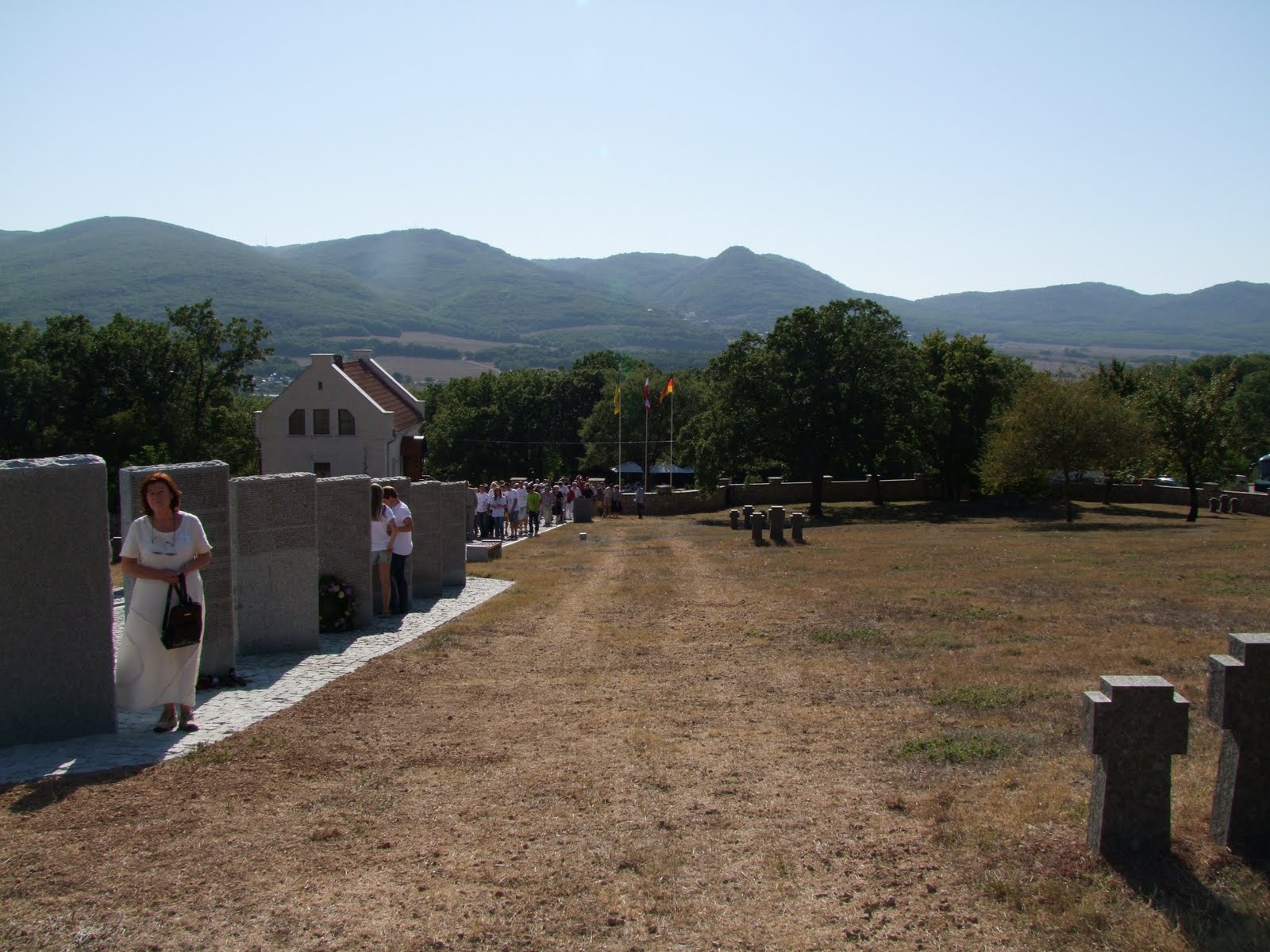
If you go to Google maps, and type in "Honcharne, Sevastopol, Ukraine" you will come to this spot. And if you go to the pull down menu in the upper left, you can see photos of the cemetery. Pull back from this view and you will see what a pretty spot this is, in hills that rise up from the Black Sea, just east of Sevastopol.Thursday, August 18, 2011
The letter that gives the blog its name: 8th November 1943
8 November 1943
Dear Leo
I’m sitting here at home for a few hours leave, and my thoughts are with this coming Christmas--what will happen and what it will be like. Will we all be together? As you know, Andi is in Paris with his company until the holiday. That boy has luck like no other. Naturally he’s getting leave at Christmas, Edina too, and so am I, I hope. And as for you? It’s high time you were allowed home, don’t you think?
I suppose you’ve heard that good old Oberhummer has gone to the other side. With him, a big part of our childhood has died too. We will no longer see him puttering around in the garden. It is as though everything from our youth is dying away. Leaves are falling everywhere, and winter is here. Oberhummer was always for me an ancient relic, somehow secretive and not quite of this world. We often discussed what it would be like to actually die. He would grin broadly at me like a good natured troll, a smile that I can see vividly as if it were yesterday.
It makes me see clearly how we are getting older. Time is running away from us like sand through an hourglass. So fine, that you don’t even notice is slipping away, and yet it is always disappearing. Our parents are getting older and are getting grey hair and need our help more and more. In time they will put their destinies, with everything that they have and are, into our own hands. For us to protect. And we will look after them with great joy and pride, because we will want to do for them what they did for us. This is tied to the sorrowful realisation that the beautiful world we inhabited as children is no more.
But one thing we have from this time: the glorious memories of our enchanted youth. No one will be able to rob us of this, even if times become even worse than they are now.
Please excuse these ramblings--they are errant thoughts escaped! I was just letting my pen dance across the page, as it wished.
See you soon at Christmas!
Your brother,
Rudolf